
Preparing a grading submission — the sleeve, team-bag, and toploader order that actually protects cards
The layer-by-layer packing workflow for cards headed to a grading service, the handling mistakes that damage cards before they arrive, and how to pack the outer box.
Every grading service publishes its own submission requirements, and those are the ones to follow to the letter — order forms, tier definitions, and what a specific service wants inside a team bag all vary, and this isn't the place to guess at another company's current policy. What doesn't change is the physical logic underneath the paperwork: a card that reaches the grader in the same condition it left your hands has been protected by layers, in order, the whole way there. Skip a layer and the one underneath it takes the damage that layer was supposed to absorb.
The stack, inside out
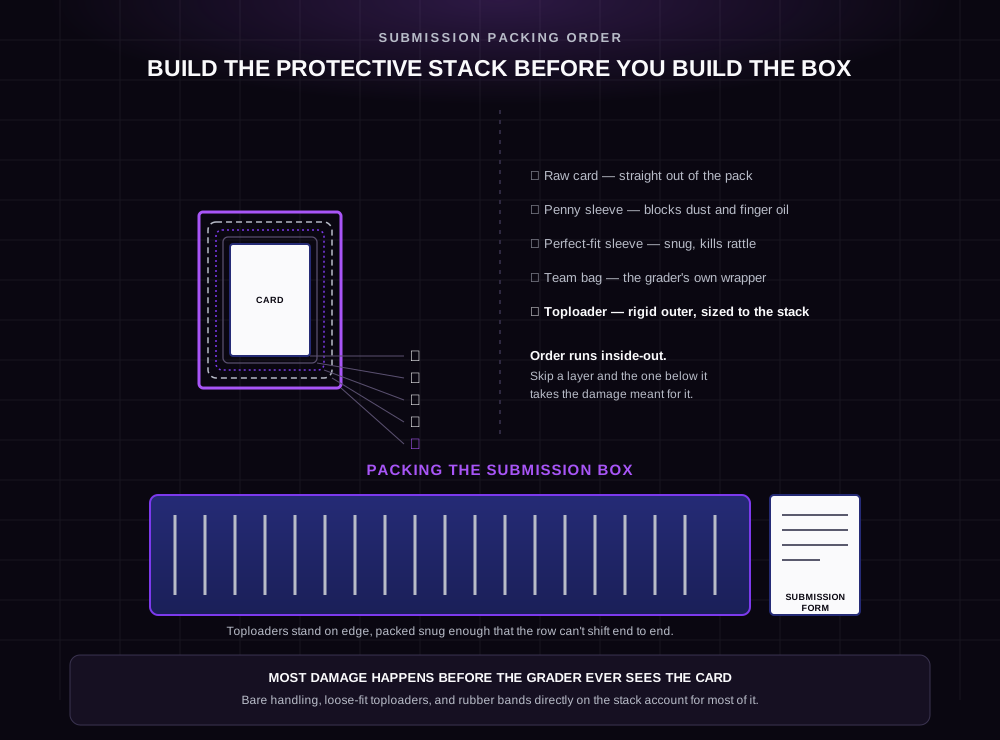
Working from the card outward:
Penny sleeve. The first layer, and the one most people already do out of habit. A thin poly sleeve keeps finger oil, dust, and surface contaminants off the card the moment it's out of the pack or the box. It does almost nothing for impact protection — that's not its job.
Perfect-fit sleeve. A snugger inner sleeve that goes over the penny-sleeved card. The point of "perfect fit" is in the name: a sleeve cut close to the card's actual dimensions removes the slop that lets a card shift and rub inside a toploader. A loose sleeve inside a toploader behaves like a loose slab inside a case — it's free to move, and movement against a hard wall is what causes wear.
Team bag. A small poly bag sized to hold a sleeved card, sometimes with the toploader itself. Different grading services want different things in a team bag — sometimes just the card, sometimes the card plus a submission label — so this is the layer where the specific service's current instructions matter most. What team bags do generally is add a soft outer layer that keeps a toploader from knocking directly into its neighbors inside a stack.
Toploader. The rigid outer shell, sized to the finished thickness of everything inside it — the card, plus every sleeve layer, plus the team bag. This is where thickness selection matters: a toploader picked to fit the bare card, rather than the whole sleeved stack, will be too tight once the perfect-fit sleeve and team bag are added, and forcing a stack into an undersized toploader is its own damage risk. Size the toploader to the stack, not the card.
What actually damages a card before it reaches the grader
Most pre-grading damage isn't dramatic. It's small, repeated handling error:
- Bare-hand handling — oil and moisture transfer happens fast, and it's cumulative across however many times a card gets picked up and looked at before submission.
- Sliding a card in and out of a toploader repeatedly to check corners or centering. Every pass is friction against the corners, which is exactly where grading is least forgiving.
- A loose-fit toploader that lets the card rattle in transit — the same fit problem as an undersized case for a slab, just at a smaller scale.
- Rubber bands wrapped directly around a stack of cards or toploaders with no separation. The corners under the band take concentrated pressure, and thin rigid edges chip under sustained pressure faster than people expect.
- Sunlight and heat. A stack of cards left on a dashboard or near a window can fade or warp over even a short exposure — this is a storage-condition issue as much as a handling one.
- Writing directly on a toploader or team bag with a hard-tipped pen pressed too firmly, which can transfer an impression through to the card underneath.
None of this requires exotic equipment to avoid. It requires treating the card as fragile at every single handling step between the pack and the submission box, not just at the ones that feel risky.
Packing the submission box
The stack described above is the protection for one card. The submission box is the protection for the whole shipment, and the same logic — nothing should be able to move — applies at that scale too. A row of toploaders standing on edge, packed snugly enough that the row can't shift end to end during transit, holds up better than the same toploaders loose in a box with room to slide and knock against each other. If a service asks for a specific tray, divider, or order within the box, that instruction exists to keep cards from shifting relative to each other and to the paperwork — follow it exactly rather than substituting your own packing method.
Keep the submission form or inventory sheet with the shipment, not loose inside a pocket of the box where it can shift away from the cards it describes. And keep a copy for yourself before the box goes out — it's the one document that tells you, and the grader, what was supposed to be inside.
Stock the workflow: penny and perfect-fit sleeves, toploaders by thickness, and shipping mailers for the outer box. New to UBIQ WORLD? Apply for a wholesale account.