
Renting vs. buying show displays — lockable display cases for your first shows
Display equipment is bulky to store, awkward to transport, and only earns money on show days. When renting a case or tower beats owning one, what changes as your show calendar fills up, and how to spec a first booth without over-buying.
Show day starts with a truck full of gear and ends with the same gear, minus a few sold cards, going back in the truck. In between those two moments, a locking glass display case or an LED tower is the best money you spent that weekend — it is what makes buyers stop, look, and trust that what is inside is worth asking about. The other 360-some days of the year, that same case is a large, awkward object that has to live somewhere, and somewhere is rarely free.
That tension — essential on show day, dead weight the rest of the time — is the real question behind renting versus buying display equipment. It is not really about which option is "better." It is about matching the equipment to how often you actually work a floor, and being honest about what each option costs you in ways that never show up on a price tag.
What display equipment actually costs you
Purchase price is the number everyone quotes, but it is rarely the number that decides whether owning was the right call. A 6ft locking case or a display tower has to be stored somewhere between shows — a garage, a storage unit, a spare room — and it does not compress. It takes up the same footprint sitting idle as it does on the floor. If you are running a home-based operation, that is shelf space, closet space, or a whole corner of a room, indefinitely, for something you use a handful of weekends a year.
Then there is transport. Glass panels and vehicle interiors do not mix well over repeated loading and unloading — a case that rides loose in a hatchback, or gets stacked under other gear on the way to a venue, accumulates chips, hairline cracks, and loose hardware faster than most sellers expect. Replacing a cracked glass panel, or the whole case if the frame gets bent, is not a small errand — it usually means the unit is out of service for the next show while a replacement gets sourced. Towers have their own version of the same problem: shelving that racks out of square after a few van rides, connectors that wear loose, panels that scuff.
None of that shows up on the price tag. It shows up in the space you give up between events, the wear you absorb every time you load in and out, and the risk that the one weekend it matters most, the equipment you own is the one that is cracked, missing a part, or still packed in a unit across town.
When renting wins
Renting makes the most sense in exactly the situations where owning is hardest to justify:
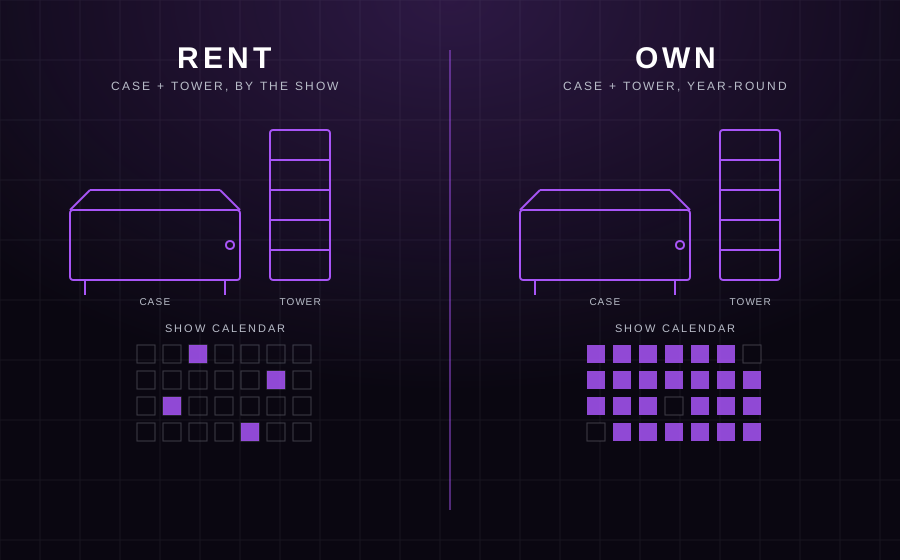
- Your first few shows. Until you have actually worked a floor, you do not know whether your inventory wants a locked case, an open browsing tower, or both. Renting lets you test formats show to show instead of guessing up front and living with the wrong equipment.
- You vend occasionally. If your calendar has a show every month or two rather than every week, the storage and transport costs of owning outweigh what you save versus renting for each event.
- You are flying or travelling to a show. A locking case does not fit in checked luggage, and freighting one to an out-of-town event usually costs more than a local rental. Renting on arrival, or through a local supplier, removes the transport problem entirely.
- You are still figuring out what sells. Renting a case for one show and a tower for the next is the fastest way to learn which format actually moves your stock, before you commit storage space and a purchase to the wrong one.
When owning wins
Owning starts to make sense once your show calendar has real density. A vendor working a floor monthly or more is putting enough hours behind the glass that the per-show cost of ownership drops below what renting adds up to over a season, and having equipment on hand means never being blocked by someone else's availability the week before a show.
Owning also matters once your booth has a look you want to control. If you are running a custom layout — specific case placement, branded signage built around a particular tower size, a table configuration you have refined over several shows — that setup is easier to protect and repeat when the equipment is yours and does not change from rental to rental. At that point the equipment stops being a logistics question and becomes part of how your booth reads to buyers walking the floor.
Speccing a first booth
For a first show, the simplest spec is one of each: one locked case for anything high-value that needs a buyer to ask before they touch it, one tower for browseable bulk that rewards people picking through it themselves, and a table kit underneath to keep the front of the booth clean instead of improvised. That combination covers both ends of how buyers shop a floor — the case earns trust on the expensive stock, the tower keeps traffic moving through everything else — without over-buying equipment you have not yet proven you need. For more on how to lay that out on the actual floor, see our booth layout guide.
How equipment rental works here
Display equipment through UBIQ WORLD is available by the event or by the week, with a refundable deposit on each unit. Availability is shown per item, so you can see what is open before you commit to a date. Request a booking and we confirm dates and terms directly — there is no guesswork on what a specific rental includes. Browse current lockable display cases on the rentals page.
Once you know what your booth needs to protect, pair your display equipment with the right graded card storage for the cases themselves, and revisit the booth layout guide for how to place everything on the floor. Ready to stock up ahead of your next show? Apply for a wholesale account to get access to case pricing.